

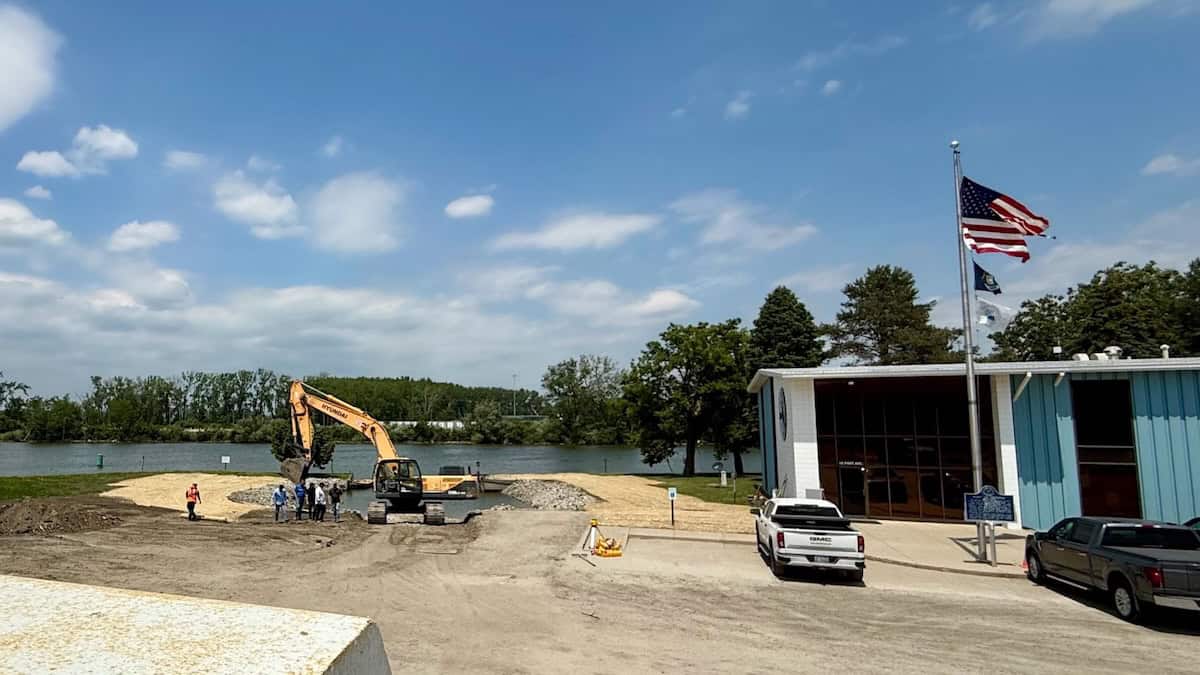
Voltaic Marine has broken ground on a new testing facility in partnership with Michigan’s Port of Monroe.
The development comes as the company continues to shift its focus into a full-scale maritime technology company.
The company was founded by Richard Phamdo, who prior to setting up Voltaic Marine spent more than a decade building and advancing electric and autonomous vehicles.
Based in Michigan, Voltaic Marine began with designing and manufacturing high-performance electric wake boats.
The company has now developed an electrication and autonomy platform and is applying it across consumer, commercial and defence markets, with Richard believing that companies need to have several products and segments to offer its customers.
Research and development
A company organised around one type of boat cannot scale he says, as it needs volume in order to fund research and development.
Instead, he explained that Voltaic Marine built the technology first and made it portable, enabling the same powertrain, battery and software to be moved into almost any hull, regardless of what that hull is meant to do.
The company has now split, with Voltaic Marine becoming the parent entity that owns the the technology roadmap and the stack. The consumer boats and the defense segment each carry their own identities.
While the consumer side is built to pull people back onto the water and the defense side answers a very different set of questions, both sectors are able to use the same engineering.
Real-world testing
The company is now planning to expand its autonomous sector further, with the new site serving as the proving ground for the company’s uncrewed surface vessel (USV), the AEU39.
Direct water access and specialised infrastructure is set to allow Voltaic Marine to accelerate real-world testing, refine unmanned capabilities, and push the boundaries of marine innovation.
The AEU39 is engineered for reliability, power and modularity and combines high capacity payload capabilities with advanced sustainable energy options.
Features include dual-use battery architecture, a configurable hull designed for mass production, electric-propulsion integration and a patent-pending, aluminium hull.