
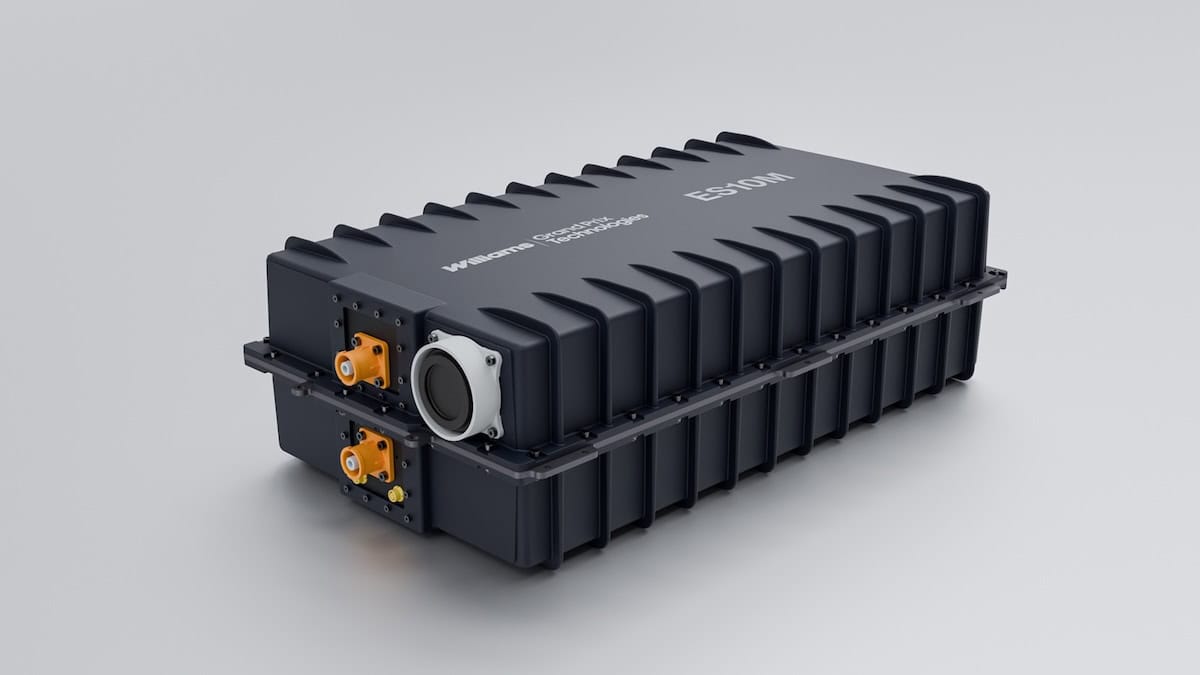
Williams Grand Prix Technologies has entered the marine sector with the launch of its ES10M, a high-performance battery system.
The system is the company’s first dedicated marine product and is designed to support a range of sectors.
Features include modular and scalable architecture, power-dense design and wide voltage range.
The ES10M delivers 200Wh/kg energy density and 325 Wh/l volumetric density at the module level.
Each module stores 9.8kWh at 50.4V and weighs 48.8kg, while the system architecture scales from 39kWh to 4.2MWh and from 201.6V to 907.2V. It is built to withstand thermal, vibration, and ingress challenges.
Layered safety architecture
Williams Grand Prix Technologies has built the ES10M around a layered safety architecture, using thermal grade materials and a cell format limit cell-to-cell propagation.
In addition, an integrated gas management system is designed for controlled venting.
The battery management system integrates machine learning with remote monitoring and diagnostics capability to continuously monitors cell and module performance while a supervisory controller can isolate individual battery strings.
The ES10M is able to predict load behaviour and anticipate fault conditions before they occur.
The system carries an IP67 ingress protection rating at module level and has been designed to maritime-grade EMI/EMC standards. Lloyd’s Register class compliance is in progress.
Marine applications
“The ES10M is the first step in our long-term strategy for the marine sector,” explained Selin Tur, managing director and chief technology officer of Williams Grand Prix Technologies.
“Designed specifically for marine applications, it reflects our commitment to bringing elite motorsport-derived engineering expertise to an industry undergoing significant technological change.”
He continued: “Formula 1 is an environment where complex performance challenges are solved under immense pressure and where excellence is non-negotiable.
“Those same engineering principles, disciplines, and standards are directly applicable to the evolving needs of the superyacht industry.”