

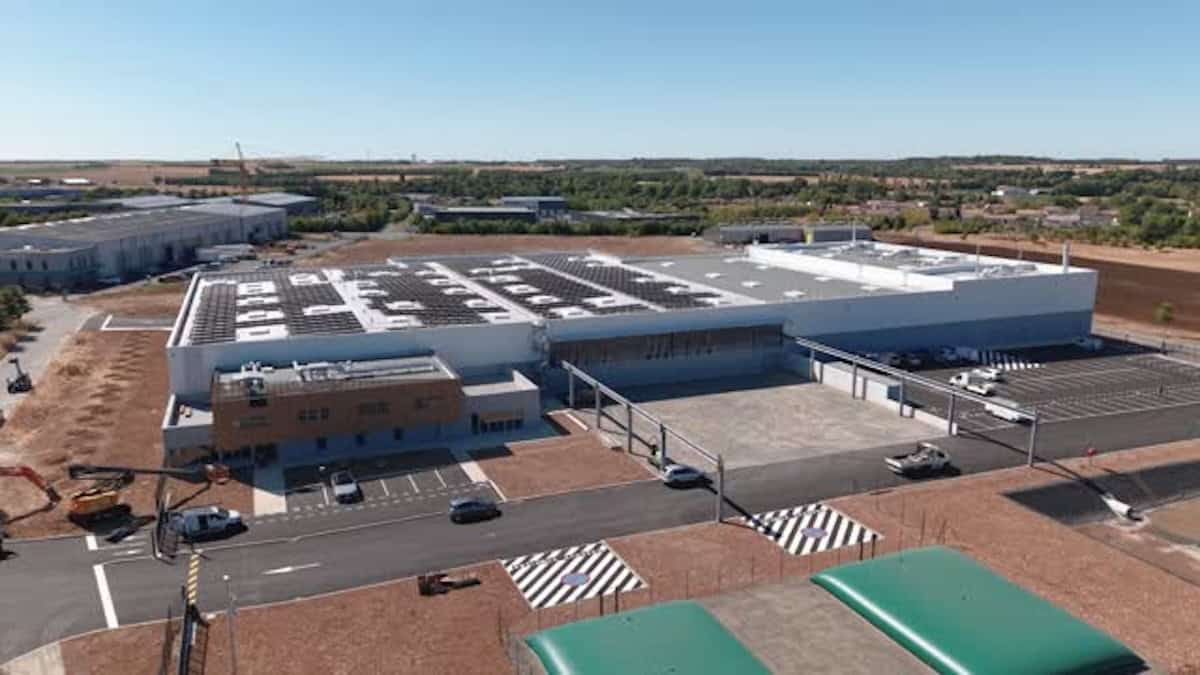
Wichard Group has invested €22m in a new industrial site for its Sparcraft brand at Sainte-Soulle near La Rochelle in France,
The project forms part of a long-term plan to strengthen Sparcraft’s position in the aluminium spar market and improve its production capability for the next 20 years.
The manufacturer of masts, booms and rigging, which has been part of Wichard Group since 2013, has transferred its activity from Périgny and other locations to the new site with the move brings Sparcraft’s operations onto a single site.
The investment – €14.5m allocated to real estate and €7.5m to industrial equipment – includes new production tools intended to improve responsiveness, quality control, working conditions and environmental performance.
Fabrice Didden, president of Wichard Group, said the investment was linked to the group’s ambition to reinforce Sparcraft’s market position.
Environmental challenges
“We wanted to position Sparcraft even more strongly as a leader in the manufacture of aluminium masts,” he said. “To do that, we needed an efficient industrial tool that would also meet the environmental challenges of the next 20 years.”
Didden said customers should benefit from the consolidation of activity, with the new site designed to support more consistent production and faster response times.
“It is a long-term promise: a promise of quality, guarantee and agility,” he said. “We will have a single site instead of multiple sites, and we will be highly responsive. That is something our customers expect.”
The site includes 23-metre anodising tanks, a powder-coating line with a 23-metre spray booth and oven, and two machining centres capable of processing parts up to 22.5 metres long, including one new machine.
Production flow
Material handling has been designed around the production flow, with loading and unloading supported by 34-metre overhead cranes and more than 2,000sqms dedicated to indoor storage of profiles and work in progress.
The new plant also has its own water treatment facility, with plans to reduce water consumption, recycle sludge from treatment and limit pollutants. The building is equipped with solar panels, and Wichard Group has also integrated a thermo-lacquering plant to support mast production for harsh and corrosive environments.
“On the industrial level, this project is very innovative,” said Didden. “It meets the environmental requirements of today and tomorrow, and it allows us to integrate the thermo-lacquering process so we can produce masts that are highly resistant in harsh environments.”
Human dimension
Didden said the human dimension had been part of the project from the start, including partner selection, working conditions and the transfer of know-how from existing teams to new employees.
“The working conditions of tomorrow had to be part of the thinking, and we also had to integrate all our teams and collaborators into the project,” he said. “The transmission of know-how, experience and expertise is an essential point for me.”
The next challenge will be to bring the new site fully into operation and help teams adapt to new tools and working methods. “Our expectations are not for the next few months, but for the next few years,” said Didden. “We have everything to prove, but I firmly believe customers will come back to us with even more willingness to see Sparcraft as a trusted partner.”