
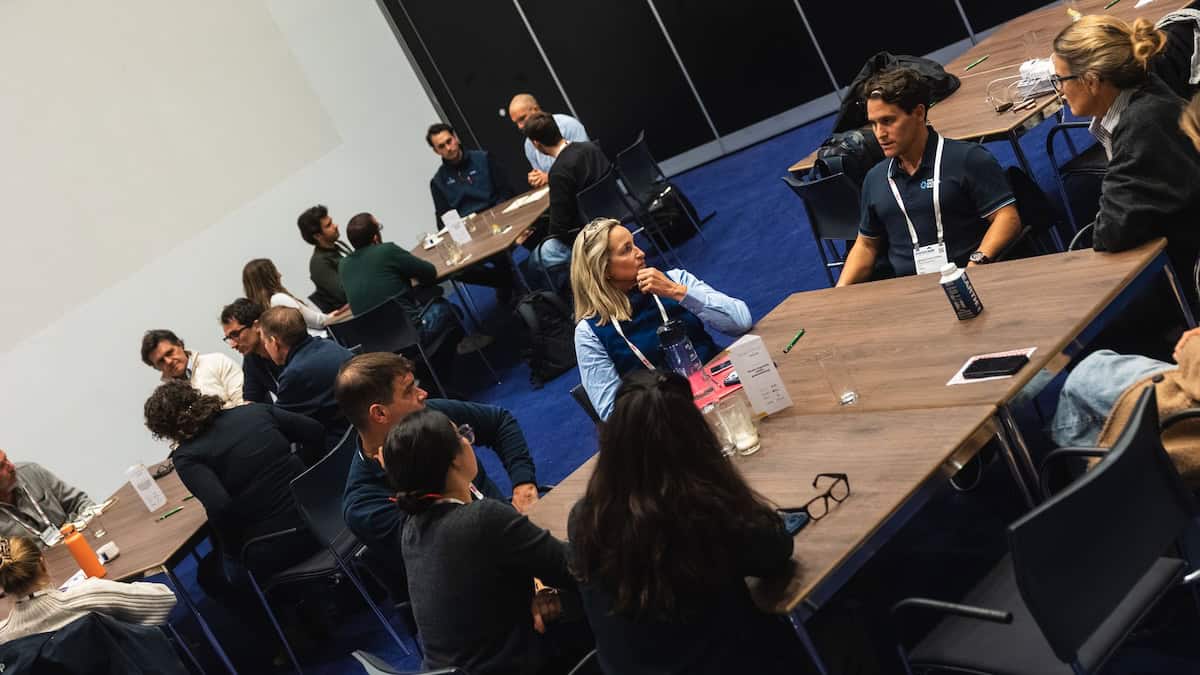
More than 50 leaders and innovators from the marine industry gathered for the Marine Impact Lab at Metstrade to explore the business case for sustainability.
Delivered by Marine Futures, Foxall Munro and Metstrade, the Lab combined product design with organisational sustainability.
Marine Futures and Foxall Munro’s work on the Lab is supported by 11th Hour Racing.
The day opened by examining the cost of inaction, challenging participants to see sustainability as a business imperative as well as an environmental responsibility.
In the Organisation track, led by Foxall Munro’s team from The Toolbox, participants focused on Selling Sustainability.
They reframed the topic through terms such as resilience, risk, reputation, efficiency and innovation, and used an ISO-based methodology emphasising stakeholder engagement and materiality to practise pitching the case to different audiences.
Blue Economy
In a round-table on Blue Economy – Financing the Future, Rick Wall, RAI’s business innovation manager and founder of OCEANOVATION, urged innovators to ‘learn the language of investors’, framing sustainability around business outcomes rather than relying on environmental terminology alone.
The Product track, Eco Design Principles, examined the financial and operational exposure created by resource dependency, volatile material prices and supply chain constraints.
Participants heard that around 80% of a product’s environmental impact is locked in during design, underlining the need to measure impact early.
Eco Design
Marine Futures’ Eco-Design Simulator had participants select design, performance and materials to develop an eco-design race boat, modelling an iterative approach of measuring, learning and improving.
Topic-table discussions on marine composites highlighted the value of Digital Product Passports, giving recyclers the information needed to process materials safely, for example where antifouling paint or PVC contains hazardous substances.
On electrification, participants stressed learning from the automotive industry and taking a whole-system approach, rethinking business models, infrastructure and supply chains rather than simply replacing diesel engines.
The day closed with open-forum discussions and a happy hour sponsored by the St. Maarten Heineken Regatta.
Key takeaways will be published in separate reports by The Toolbox and MarineShift360.