

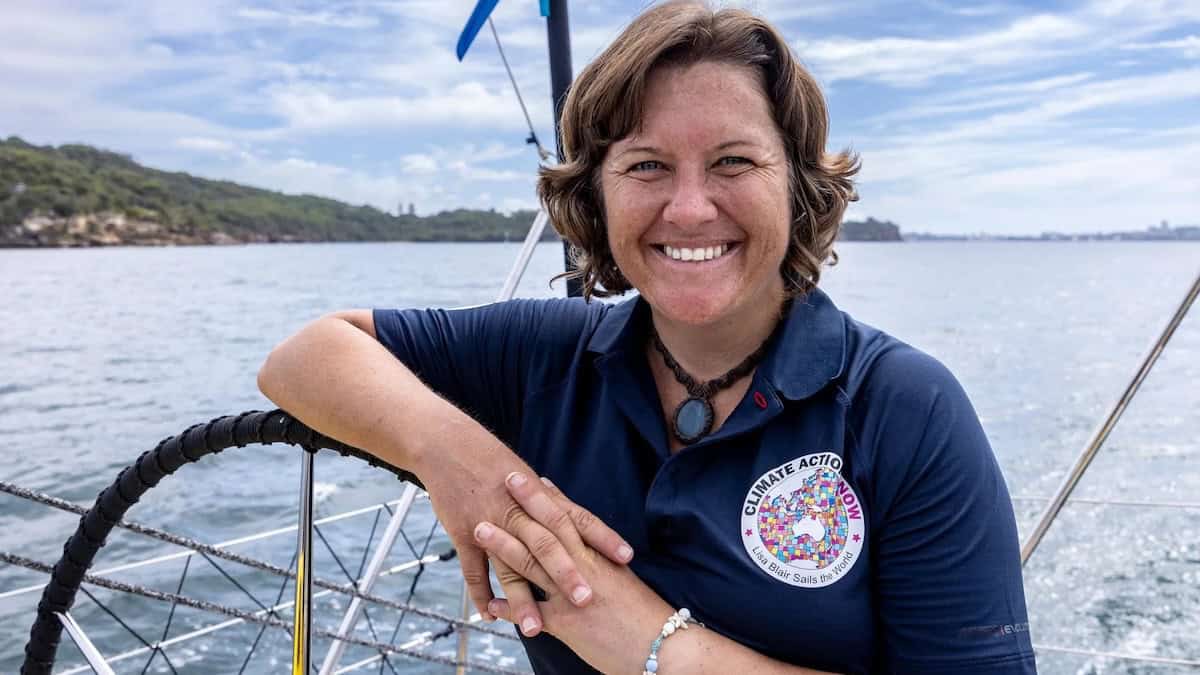
A unique joint research partnership is to investigate how to eliminate fibreglass in boat hulls.
The partnership between world record explorer Lisa Blair OAM, the Australian Composites Manufacturing CRC (ACM CRC), UNSW Sydney, and Steber International will research the viability of sustainable composites for next gen boat hulls.
The two-year, $1.9 million research partnership aims to investigate the viability of basalt fibre – derived from volcanic rock – and current bio-resins as a scalable solution to outperform fibreglass.
Researchers want to find a circular solution to the problem of fibreglass boats reaching their end of life with no scalable pathway for recycling yet in place.
Circular foundation
“Composites are transforming mobility across aviation, marine, automotive and beyond – lighter, stronger, more efficient,” explained Luke Preston, chief executive officer, ACM CRC.
“But as we accelerate their adoption, we have a responsibility to ensure we are not trading one environmental problem for another.
“The ACM CRC and its partners are committed to ensuring that the composites revolution is built on a truly circular foundation.”
The researchers point out that one solution lies in basalt fibre which is stronger than fibreglass, naturally fire resistant and also100% recyclable.
The research will evaluate combining bio resins with basalt fibre focusing on mechanical performance, scalability and circularity.
Constructing a test hull
As part of the practical validation, Steber International is constructing a test hull to investigate real-world scenarios and the repairability of these materials.
This will take place alongside focused materials research, led by advanced materials company Scientia.
The organisations hope to demonstrate a solution allowing the entire boat industry to offer more sustainable products.
In addition to this, Lisa is also independently funding an Environmental Impact Study to be completed by research organisation Soenecs through her Arctic Impact Project.
Innovation through research
Following the initial research, she will build a new expedition yacht from these sustainable materials before setting off for her next record.
The Arctic Impact Project will see Lisa setting off in July 2027 to become the first person to sail solo, nonstop and unassisted in an 8,000 nautical mile journey around the Arctic Circle in one season.
“This project is a multi-layered mission: driving innovation through our sustainable composite research, empowering communities via a global schools programme and ‘climate action now’ events and advancing science by documenting the health of our remote oceans,” said Lisa.
“By building my vessel from basalt fibre, I’m showing that adventure can, and must, be a vehicle for change.”