

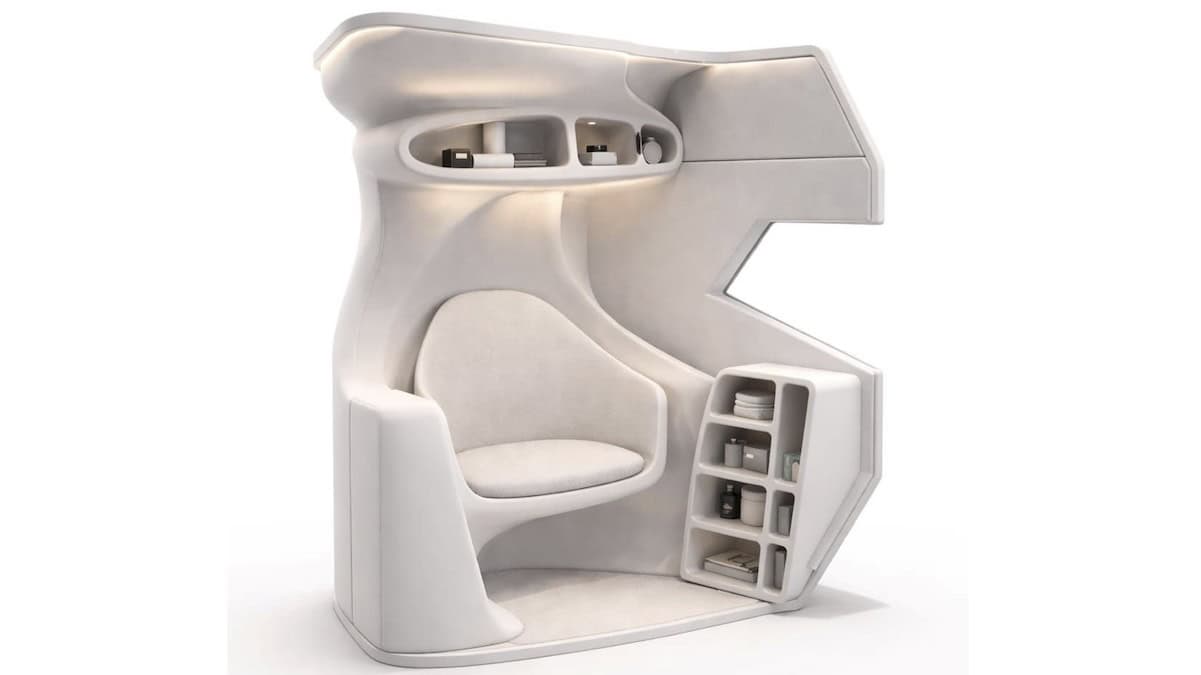
Italian based Nugae has presented its large-format additive manufacturing solution for the marine sector, showing how 3D printing can transform the way boats and large composite structures are designed and built.
The structural part on show at JEC World 2026 is made using a robotic 3D printing system. It will be incorporated into a 43ft catamaran currently under construction by the company.
The new structure uses UL-LFAM (Ultra-Light Large Format Additive Manufacturing), a proprietary robotic production system that enables the creation of lightweight large-scale structures.
The component – composed of 70% recycled material – weighs 37kg and took 42 hours to print resulting in a lightweight structure engineered for performance while embracing more sustainable manufacturing principles.
Our approach has always been guided by a very clear principle: lightweight design and process optimisation.
Francesco Belvisi
The process used allows Nugae to develop structures using additive manufacturing, reducing the need for complex molds and the machining processes.
Nugae points out that this allows for reductions in structural weight, production times and material waste. It can also expand design possibilities.
“Our approach has always been guided by a very clear principle: lightweight design and process optimisation,” explained Francesco Belvisi, co-founder of Nugae.
“We design structurally efficient components that do not require costly post-processing. The goal is to obtain parts that emerge from the printer ready for use, reducing time, waste, and complexity throughout the entire production chain.”
Robotic additive manufacturing
The project is part of the NEMO – Design 4 Yacht Flexible Customisation programme, developed by Nugae in collaboration with the Politecnico di Milano.
The system is based on a proprietary technological ecosystem consisting of a large-format robotic 3D printing platform designed to produce complex structural shells and components for marine and other industrial applications.
The system incorporates CoreLight3D, an ultralight core material made from recycled polypropylene that has been developed by Nugae for robotic additive manufacturing.
The material can be machined and is also optimised for adhesion with resins and composite laminates integrating with traditional composite reinforcement processes.
Operation of the robotic system is carried out using NU-Slice proprietary software that implements advanced slicing and material deposition strategies developed for functional structural geometries.