
The MED Group has presented the TYKUN H1, the first hydrogen-powered tender to be made in Italy.
The 12-metre TYKUN H1 is capable of speeds up to 35 knots, with extended range and built-in redundancy.
The H1 represents a step forward in the construction of hydrogen-powered vessels due to MED’s collaboration with the TESYA Group, which has developed hydrogen propulsion systems used in America’s Cup chase boats.
The H1 also taps into the hydrogen infrastructure of NatPower H which is working towards creating a hydrogen refuelling network.
The TYKUN H1 project began with a key challenge – to produce a hydrogen tender that was usable and manageable for a customer.
Ugo Casadio
The MED Group team and designer Tommaso Spadolini have worked to integrate the hydrogen system into a 12-metre hull, creating a high-spec dayboat.
“The TYKUN H1 project began with a key challenge – to produce a hydrogen tender that was usable and manageable for a customer,” explained Ugo Casadio, chief technical officer at MED Group.
“We were lucky enough to make the acquaintance of the TESYA Group team, who had just come from producing the chase boats used in the last America’s Cup.
“Key to the H1 project was to translate this experience into a boat that more mainstream customers could enjoy.”
Extending the vessel’s range
The H1’s core target specs were to use hydrogen in a manageable tender that would offer clients autonomy for a day with a range of 50 to 60 nautical miles, a maximum speed up to 35 knots, and a cruise speed of around 20 knots.
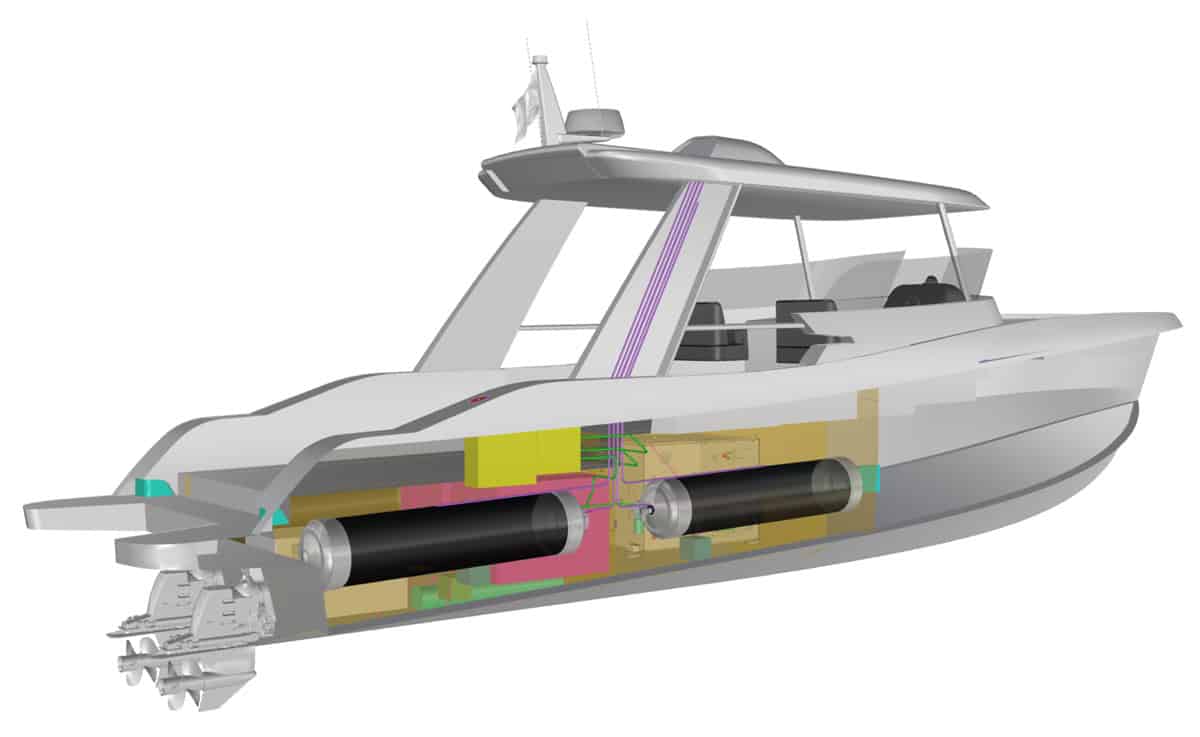
To fulfill this criteria, the TYKUN H1 has a battery bank powering electric motors. A fuel cell, powered by gaseous hydrogen, serves as a range extender by recharging the batteries and extending the vessel’s range to 60 nautical miles.
The system also includes a regular shorepower connector for fast charging.
“Building two hydrogen foiling vessels for the last America’s Cup was a good test for us because the boat performance requested was extremely high,” explained Vittorio Maccone, sales engineer at TESYA Group.
Building two hydrogen foiling vessels for the last America’s Cup was a good test for us,
Vittorio Maccone
“We gained a lot of experience, collected data and built knowledge that enabled us to re-engineer the system to create something much more user-friendly.
The work we did with MED Group on the H1 was all about building a hydrogen boat that could be used by everyone.”
Four concealed tanks hold around 32kg of hydrogen at a pressure of 350 bar.
A simplified piping system delivers the hydrogen to the fuel cell which converts it into electricity.
Equipment used in the system has been type approved by classification societies.