

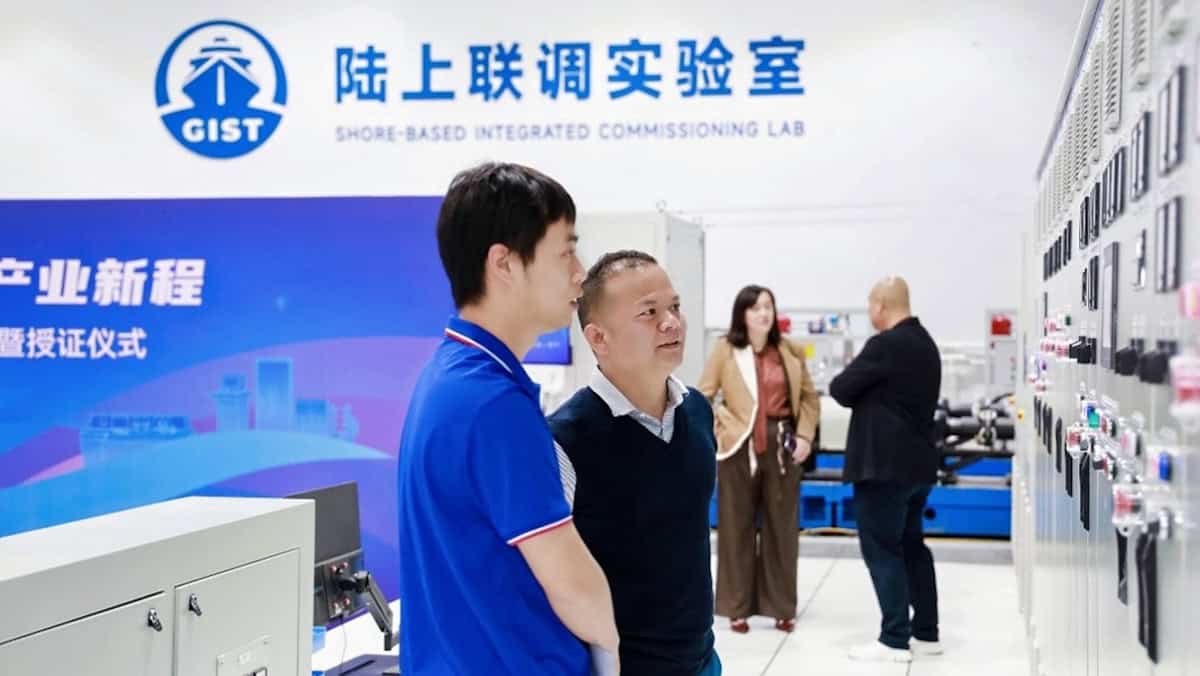
ePropulsion has opened a new test facility in Dongguan, China in association with Songshan Lake Science City Group and the Songshan Lake International Robotics Research Institute.
The 1,000sqm facility is said to be South China’s first onshore joint debugging test platform for green and intelligent vessels recognised by the China Classification Society (CCS).
The Green and Intelligent Ships Testing (GIST) Onshore Joint Debugging Laboratory is expected to support the growing marine electrification sector in the Guangdong-Hong Kong-Macao Greater Bay Area.
The facility, which will be open to the wider industry, is designed to strengthen the technical infrastructure while helping companies bring new technologies to the market quicker.
The platform also allows developers to evaluate different power architectures and identify potential risks before systems are deployed on vessels.
Danny Tao
It will enable simulation and verification of multiple marine power system configurations, including full electric and hybrid propulsion systems.
The laboratory is equipped with specialised testing equipment to support around 30 standardised testing procedures covering key components such as battery, propulsion and power, remote propulsion control, frequency conversion modules, power distribution, energy management and cooling systems.
It is also supported by a hydrodynamics laboratory, electrical simulation platform and the Songshan Lake Water Application Test Base.
Identify potential risks
“Companies in the Greater Bay Area can now conduct authoritative testing aligned with CCS standards locally, significantly shortening R&D cycles and reducing certification costs,” explained Danny Tao, co-founder and CEO of ePropulsion.
“By simulating real operating conditions, the platform also allows developers to evaluate different power architectures and identify potential risks before systems are deployed on vessels.”
Professor Li Zexiang, founder of the Songshan Lake International Robotics Industry Base, added that the laboratory could become an important connector within the region’s innovation ecosystem.
And he explained that by leveraging the Greater Bay Area’s industrial supply chain, the facility can help accelerate the transition from technology R&D to real-world industrial applications.