
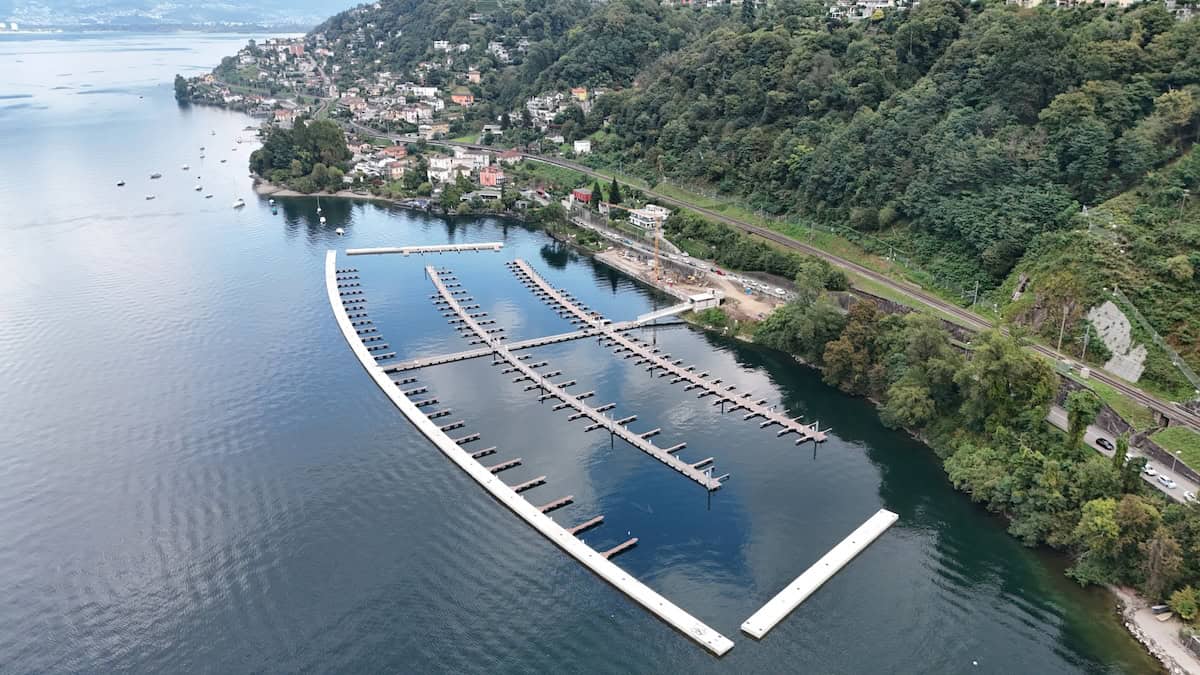
Engineers have rethought conventional harbour design with the construction of a new marina on Lake Maggiore in Switzerland.
Historically, the area has historically been inaccessible to sailors with a steep and rocky coastline and large variations in minimum and maximum lake levels meaning a traditional marina was not feasible.
In addition, one of the client’s requirements was to avoid a manual adjustment system for the mooring devices on the lake bed, which meant that systems with chains or elastic ropes had to be ruled out.
Instead, engineers have designed and constructed the Port of Gambarogno using a false seabed system for foundations that are not anchored in the lake’s bed.
Freeing the structure from the sea bed
The system consists of large three-dimensional structures submerged and hinged near the shore which are used as the basis for the subsequent floating breakwater barrier.
Vertical piles are then inserted into the structure for mooring the jetties in a solution that frees the structures from the lake’s bed.
The breakwater barrier is located at a distance approximately about 130m from the shore, with jetties and fingers for mooring boats.
19 million Swiss Francs
The new facility will accommodate 280 boats between 8 and 20 metres in length on the floating structures: a total of 440 metres of 3 metre-wide pontoons, a 96 metre-long and 4.5 metre-wide pier and 137 mooring fingers.
The new marina is designed by a number of specialist engineers and suppliers, with construction of the port the last stage in a process that began in 2016, supported by a budget of 19 million Swiss Francs. Completion is planned for 2027.
The facility was designed by Studio Sciarini in collaboration with Consorzio Officine Ghidoni and Implenia Svizzera for the submerged steel structures, Matteo Muttoni Costruzioni for the floating wave breakers, Ingemar for the piers and floating jetties and Comar for the assembly of the underwater structures and the installation of the floating piers.