

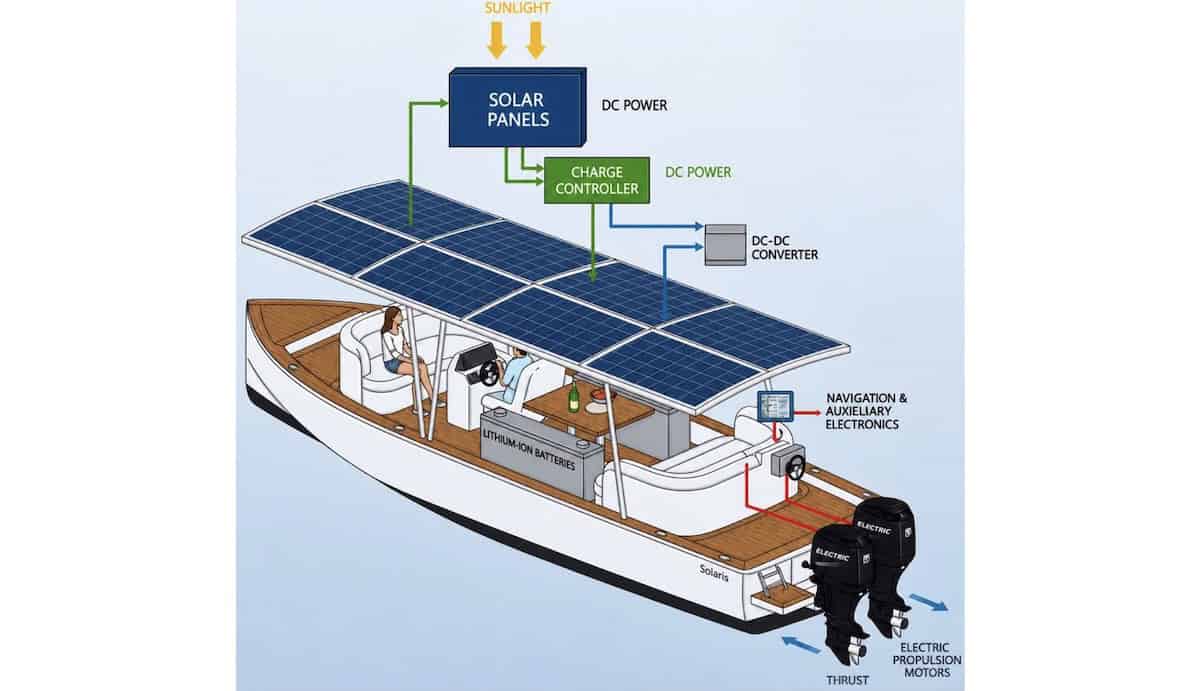
Researchers at Memorial University of Newfoundland in Canada have modelled a solar-electric propulsion system for a pleasure boat operating under Mediterranean conditions, reporting sufficient generation to meet baseline propulsion demand in simulations.
The study, Integrated modeling and performance assessment of a stand-alone PV-battery system for a solar-powered pleasure boat combines location-specific energy yield estimates from HOMER Pro with dynamic modelling in MATLAB/Simulink.
The findings are computational results rather than evidence from full-scale sea trials.
The proposed vessel measures 11.8 metres long and 5.8 metres wide, with capacity for five to six adults.
Using a full-load displacement of approximately 2,250kg and a target speed of 5.4 knots, the team selected two 2.5kW brushless DC motors.
Estimated energy demand was 30kWh for six hours of daily operation.
Surplus generation
The design uses 32 solar modules rated at 330W each, providing a 10.56kWp array covering approximately 62.4 square metres.
Four independently controlled subarrays connect to a shared 48V DC bus through separate boost converters with maximum power point tracking.
Storage comprises eight lead-acid batteries forming a 48V, 410Ah bank with 19.68kWh nominal capacity.
The energy management system limits charging current to approximately 50A and curtails surplus generation.
Using solar resource data for Larnaca, Cyprus, with average daily irradiation of 5.43kWh per square metre, the researchers reported peak simulated output of nearly 10.98kW under local clear-sky conditions and an excess energy margin of 39.8%.
Depth of discharge
Simulations examined solar-only, combined solar-battery and battery-only operation. Reported results included DC-bus voltage variation within ±3% of its nominal rating and approximately two hours of reserve propulsion without solar input at full rated load.
Battery depth of discharge remained below the specified 80% limit.
The team identifies potential benefits from removing onboard fossil-fuel consumption, including lower local emissions, noise and fuel-spill risk.
Physical trials will need to validate performance and hydrodynamic drag.
Future work could explore greater storage capacity, lithium iron phosphate batteries, battery degradation modelling and detailed lifecycle economics.
The researchers propose extending full battery autonomy to six to ten hours.