
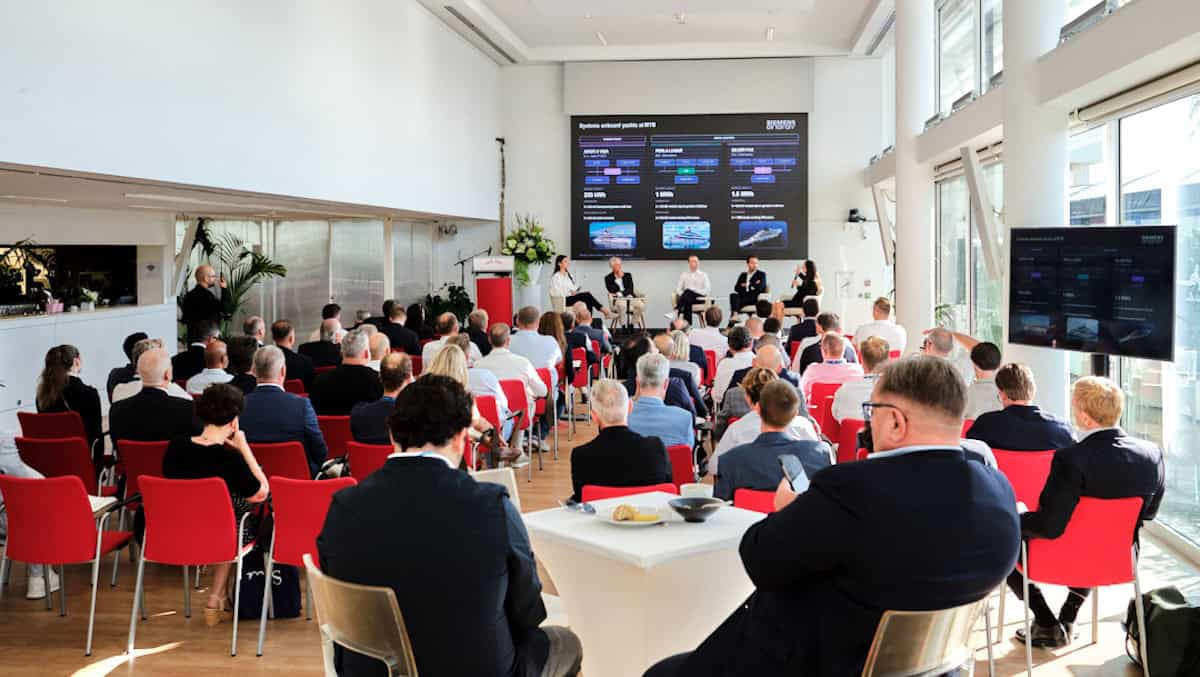
No single technology or fuel can meet every yacht’s future energy needs, according to discussions among 128 superyacht captains and international specialists at Yacht Club de Monaco’s 31st Captains’ Forum.
The World Maritime Day event examined wind, solar, batteries, hydrotreated vegetable oil (HVO), methanol, hydrogen, LNG, ammonia and nuclear power. Its central conclusion was that choices must be matched to each vessel’s operating profile, required range, available space and access to fuel or charging infrastructure.
Renewable generation and batteries are already being used at sea. Aeroforce reported that its electric catamaran had covered about 17,000 nautical miles, with 30–35% of its energy supplied by solar power and the remainder largely generated under sail. “Nothing runs on just a single source,” said Jean Guyon of Aeroforce.
Dual-fuel engines
Speakers said the focus of electrification is moving towards system integration and energy management. Larger batteries may extend range but add weight, so capacity must be sized around intended use rather than treated as an objective in itself.
HVO offers a relatively accessible route for compatible engines. Rolls-Royce said it could be used without loss of power and blended with conventional diesel, although availability varies by region. Methanol requires greater modification, but dual-fuel engines can retain diesel as an alternative where bunkering networks are limited.
Other options face tighter constraints. LNG needs more storage volume than marine diesel, together with cryogenic tanks and extra safety equipment. Ammonia produces no onboard CO₂, but its lifecycle impact depends on production.
Hydrogen fuel cells eliminate NOx, CO₂ and particulates at point of use, yet storage volume and refuelling remain significant barriers. Regular point-to-point operations may suit compressed hydrogen, while less predictable cruising could favour methanol.
Regulatory readiness
Nuclear technology is also being explored, including Lloyd’s Register work on vessels from 65 to 120 metres. Engel-Jan de Boer of Lloyd’s Register said existing rules were written for older reactor designs. “The technology is there,” he said, but regulatory readiness and acceptance by flag states, ports, nuclear authorities and insurers remain major obstacles.
Infrastructure emerged as a recurring constraint. Philippe Esposito of DH2 Energy said of hydrogen: “The problem today isn’t the boat. It’s the infrastructure: how to refuel boats and get hydrogen to the marinas.”
Commercial adoption will also depend on fuel price, availability, regulation and finance. Speakers warned that designing a vessel around one technology could affect its future valuation, while adaptable systems may reduce risk. Captains were identified as essential to ensuring that solutions which work in theory remain practical in operation.